Sunday, September 29, 2013

How To Pick The Right Bed Sheets & Bed Linen

It is a pity that when speaking about the home improvements the first thing that comes into one’s mind is a new kitchen or a bathroom. So many people still do not think of their bed linen and bedding as a part of home improvement process, and that is a shame. After all, you can completely change the appearance and the experience in your bedroom simply by changing your bed linen and that is such a tiny cost to pay for this significant renewal.


Easy care bed linen was very popular in the past, which is so not surprising, if taking into the account the amount of hard work that had to be done at a home laundry. Long time ago the washing of bedding and other items could have taken all week. Fortunately, the quality as well as the convenience of washing machines nowadays allow people finally to be able to feel free to find and use bedding that is really desired for their bedroom. There are hundreds and hundreds of choices out there for all the different colours and designs.


The choices are excellent, but one may be wondering how they can be narrowed. There are three main factors that are used to describe sheets: type of material, fibre length and touch. If you want your sheets to be strong, soft and good quality you should strongly consider 100% cotton. Polyester sheets are not completely bad, but not so pleasant to touch, however do not require so much ironing. Cotton is advantageous because it can absorb moisture, and sheets are more pleasant to touch. Egyptian cotton is a more expensive version in the family of cotton bed linen, but it makes softer sheets and also has some additional advantages.


Fibre length has nothing to do with benefits to your health, but it is very important in making the decision of which bedding to choose. If you are expecting to get the high-quality sheets, you should expect at least 200 thread count. The higher this number becomes the better and more luxury sheets you can expect. However the price is also something that depends on the thread count. High thread count has a lot of advantages including better performance during washing, increased softness and overall appearance. Low thread count tends to become thicker and quickly fall apart. Typically, most people tend to look for 200-400 thread count to increase the quality, but to minimize costs.
The third and last point is a touch. This can be determined by the type of the cotton, thread count, weaving, colouring and other processes. Italian weavers often work very well so naturally their fabrics are one of the best in the world but prices also tend to be higher.


There are several reasons of choosing different bedding materials such as flannel, silk, satin or linen. Some obvious advantages of flannel are that it performs excellent thing during cold winters. On the other hand satin and silk can have the same effect but be of a “higher class” because of their luxury. Silk is a fabulous material, but it can be expensive to dry clean your sheets every week, if you want to take a proper care of them.


There may be a lot of choices out there, but the number of key performers is not so overwhelmed. If you start to narrow it down say to the range of 200 – 400 thread or start looking for some more sophisticated material like silk you can realise that the number of choices has dropped . This may take some effort and you may even have to do some decent research until you find exactly what you are looking for.

4 Reasons Of Not To Have A TV In Your Bedroom

Pros And Cons Of Having A TV In Your Bedroom
Today we (me and my boyfriend) had a serious argument on whether or not a TV set should be included into our bedroom’s design. Some say that this is a good and even a luxury while others do oppose to the idea as it is not good for your health and a good sleep. One of the opponents of having a TV in the bedroom I found was Joshua Becker (I still have to find out if he is an interior designer as he simply introduces himself as a minimalist in his byline.

Anyway after years of having a TV in his room he ran an experiment of actually removing it out of his bedroom. Believe it or not he could come up with 18 (18!) good reasons to get rid of the TV and it was extremely fun to read them. He lists things like getting more sleep as Americans are likely to spend over 35 hours a week in front of a TV and some of those hours must be taken from a sleep. Things like ability to reflect or plan your day can also be influenced by having/ not having a TV close to your sleep place. Well for sure I agree with many of the causes like “a good example for kids” or “more conversation with your partner”. I was particularly interested in the arguments that advertisement in fact does influence you while you are at your weakest – just before or after your sleep. Nobody of us likes or wants to be controlled. Basically I would categorize his ideas on why it is good not to have a TV in your room to four major groups:
-
1. Better relationship with your kids/spouse
2. Better personal performance (more peaceful mind, etc.)
3. Better time management (less rush, more valuably spent time)
4. Good impact on your home atmosphere (energy saving, less dusts in bedroom, less potentially-harmful- waves, etc.)
Now on the other hand it is so cool – particularly in cold winter nights to come back home after a tiring day and dive into the soft bedding of your bed, turn on a TV (or a laptop with a good movie in our case) and turn off your mind. TVs can be a stylish accent in one’s bedroom. I looked into this further and found some nice examples of a TV incorporated in bedroom’s design. The fun thing is that apparently a TV can be included in many different style bedroom interiors.

While some of those pictures (and designs) are awesome, in the end however we finally decided against placing a TV in the bedroom. The main reason was that we both love never ending discussions so much especially when we are in bed – and a TV might bit by bit take away this awesome tradition from us.

Bedroom Colours: White

White is more popular in the bedroom than in no other room, and no wonders – white does symbolize peace and calm after all. White is also believed to be the colour of sanctuary. Where else would you need to enjoy such qualities than in the bedroom?
Steven Whitehead, who has been a bedding stylist for 15 years, says that the white bedding has a certain mystique and when you go into beautiful spa hotels, the beds tend to be all variations of a white theme and it all allows people to completely unwind and just to be.


It is believed that white is very delicate, and it will instantly let you know when it’s soiled. Because of this and many other reasons, a successful white bedroom should, in principle, be the easiest of all concepts to achieve. However, in fact, to decorate a white bedroom that really works requires just as much – if not more – thought than any other room in the house.
Mr Whitehead also emphasises that the “great thing of a white bedding is that it’s so easy to update. you can simply add a new element, a new coverlet, a new sham, a new decorative pillow and all of sudden you have a beautiful new room It is timeless, it’s classic and you will always be able to use it.”
The tone or tones of the background white in a bedroom require a deal of thought: brilliant, bright whites are possibly too unforgiving for a room should be designed to soothe, and can look unwelcomingly stark – quite the opposite from the required effect. Better to look at the palette of creamy whites — buttermilk, parchment, cream — tones which give warmth while retaining their neutral status. Again, two or three shades of these whites used together gives a much deeper, more satisfying appearance than one shade alone, particularly when the woodwork is coloured in such a way that an imperceptible difference can be seen between it and the colour of the walls. Accents of contrast colour are fine, of course, but, on the whole, the bedroom is not the place for making your most challenging colour statements. Not only is it a room generally used to relax in, it is also where you wake up and the space to which you retreat in times of illness.


Another interesting thing is mentioned, that they “can take on any number of personas, it can be very clean and masculine, very organized and geometric, it can be very romantic with ruffle with beautiful heirloom linens, it can take on any type of identity you need it to take on”. Mr Whitehead also explains, that seasonally it can be done with lightweight, wool blankets, lightweight cotton blankets to make it from summer to autumn, from winter to spring and then again to summer. HE also mentions one good trick how to easily and quickly freshen and to ease out wrinkles- simply take a bottle of water and spray it all over. That can be done in your guest room to freshen sheets or a duvet just before your guests arrive.


Tuesday, August 20, 2013

Feng Shui: Bedroom Colours

What Is Feng Shui ?
Feng Shui – is an ancient Chinese philosophy. Feng shui shows us how to live in harmony with everything that surrounds us, and how to harmonize human environment with his internal being.
Healthy living is based on the way we know how harmonise our own selves with your surroundings.
Only combining those two can bring the inner peace. It then becomes easier to solve problems and turn your approach to the world into positive and optimistic.

Five key elements

To understand the impact of colors and fabrics, it is also important to understand “chi”, the five elements theory of the fundamental life energy transformations.
There are five elements of life:
• Wood
• Fire,
• Earth,
• Metal
• Water.
These elements have a certain order- a cycle of dependence.
Wood creates fire, fire creates earth, earth creates metal and metal creates water and only because of water a tree can grow. It is a continuous and complete cycle of life.
Under the basis of this philosophy it is possible to create both- interior and exterior of living spaces in order to improve the quality of life, most importantly- a certain mood.

Colour Schemes For Your Bedroom

When choosing colours, you should firstly have in mind that you need different colours, during the different stages of your life. For example a person who’s main element is fire, do not necessarily need red in his surroundings. Therefore, if your inner voice tells you something contrary to the rules of Feng shui – it is better to rely on your instincts.


In order to have comfortable sleep and a good rest, we must feel comfortable and safe in our bedroom. This can be achieved by organising bedroom area properly and choosing suitable bed and other bedroom furniture for it.
The flow of energy in bedroom should be quiet and tranquil so this room should be kept away from the entrance to the house.
Bedroom furniture should be light and low. Dark colours are inappropriate, as you would not create an easy and fluent energy which is required for a good sleep and deep relaxation.
It is better to have a rectangular shaped bedroom, as it is easier to divide space between partners more evenly. This might even lighten all potential fights and conflicts that could rise especially if one of partners is more dominating.
Bedroom colour schemes should be gentle and relaxing:
• Light blue symbolizes rest and relaxation,
• Light red (rose) colour can bring mutual happiness and connection
• Yellow would encourage both of partners to share more and get along better with each other.
Bring more harmony into your life by selecting the correct colours in Feng Shui.

Sunday, July 7, 2013

What Is Colour?

Byline:
The above written colour theory can be perfectly applicable to an interior design


Colour is the brain ‘s interpretation of the different wavelengths of visible light waves. The study of colour and our everyday experience of it is a mix of both art and science. Scientists, artists and philosophers have proposed different ‘colour models’ as they try to explain how colours work. These models look at attributes of the colour such as hue (the actual colour of something), saturation (how pure the colour is versus how grey it is), and brightness (how much white or black is a part of the colour). Using these parameters, most colours can be described.

A helpful tool for considering the relationship between colours is the colour wheel. It takes the linear spectrum seen when light is refracted through a prism, and joins the free ends to create a circle. Although this means that colours from opposite ends of the spectrum (red and violet) are now adjacent on the wheel, the effect is a seamless progression of colours from any one point on the wheel to any other point. While one colour model may be based on different assumptions about its primary colours to the next model, most are consistent in their placement of colour around the wheel. The wheel allows us to visualise and define colour harmonies; that is, collections of colours that work together to create a usable scheme. Neutral colours can be important for decorative schemes. True neutrals are black, white and greys, but in decorative terms the word ‘neutral’ has expanded its meaning to include desaturated and less bright colours, particularly those with an earthy feel.


Research shows that colours can affect the way we feel. The effects are measurable under controlled conditions, but often do not manifest themselves to the same degree in real-life situations. The research deals in generalisations, where colours may be described only in broad terms, and the impact or modifying effect of adjacent colours is ignored. Reaction to colour is often also a function of cultural and personal experience. It is sensible for designers to be aware of the symbolism of colour, and use it where appropriate, but remember that it is only one part of a larger whole; context is all.

Friday, May 3, 2013

Colour Schemes

A visual concept can be used to dictate the colour scheme. This allows colour schemes to be derived from the brief, but there are other systematic methods of relating colours to form the basis of a scheme. Even when taking a scheme from some other form of inspiration, it may be helpful to determine which type of colour scheme is being used so that a clear understanding of how the scheme is working can be gained.

The basic types of colour scheme are named in relation to how the colours sit on the colour wheel. Following a defined structure will usually result in a workable scheme, but flexibility must be allowed. The colour wheel should guide rather than dictate. There are so many variables that it does not pay to be dogmatic about the rules of colour. For this reason, the schemes as described here should not be seen as exclusive; variations are allowed and desirable. Even in monochromatic schemes, accent colours (small amounts of contrasting colour) can lift an otherwise ordinary scheme and transform it into something special. As ever, balance is the key and judgement on these matters is something that needs to be developed.


Thursday, April 4, 2013

What Colour Is Your Bedroom?

Colour The Culture

Colour has a significant influence to both- your senses and intercourse. Different colours can create different memories, different thoughts and ideas. It is extremely important to create a relaxing atmosphere in your bedroom so you could feel cosy and comfortable. This can be also done by using specific colours and tones. It’s been quite a while since psychologists started studying psychological aspects of colours and their influence for humans’ lives and emotions.
This varies so much in different cultures. Say red is said to be an aggressive and active colour in western countries. However in China it in contrary has a meaning of calm and tranquillity. There also are countries where red can mean passion or density.

Colour Your Individuality

It is absolutely clear that the meaning of colour is a very individual issue. You want to decorate your bedroom with the colour that is just right for you, so you should look for colour that is very close and intimate for you personally as in your bedroom you should feel chilled out and relaxed.

Here is how you should do that. Take a colour wheel and look into all of its colours and tones. Try to think about each colour and try to sense your own feelings regarding that colour.  Is this a pleasant feeling? Or maybe it makes you feel sad? Does it bring a smile to your face or maybe it is so tranquil that you start feeling sleepy?


If you have now found out how does one or the other colour influence you, would you like to know what psychologists say about different effects of the different colours?

By the way do not fear to disagree. It is very natural, that you feel the other way round.  However those are the guidelines that help you to understand the common ways how people feel about colours and you can use them when trying to create an interior that would be appreciated by many (if you need that of course).

Painting The Bedroom ?

Two colours of the extreme are black and white. Black can easily draw attention and create a dark, even hot atmosphere. Unfortunately this colour does optically decrease the size of the room and it might become rather risky to use it. See you can easily overuse which might bring melancholy, sadness or even depression into your sleeping environment (which may eventually start causing bad dreams).


The completely opposite colour is white. However it may lack inspiration and be slightly cold in some ways. Most of the bedrooms have white walls however it is not always the best solution as it can suppress passion (passion is usually desirable in bedroom).
They are soft gentle and cosy, often being related to family and one’s roots they can bring back great memories. This makes them perfect for bedroom interior. It can create a warm and intimate feeling. So called earth colours are all tones of brown.


Orange is very optimistic and joyful. However it can link to food as well and provoke night moseys to the fridge which naturally leads to emotional overeating.


Yellow can also create a positive mood however only for a short period of time. You may even end up feeling annoyed at the presence of yellow wall.


Blues and Greens
would easily connect you to the tranquillity and peace as they are the symbols of water and nature.Allowing blues and greens to dominate in your bedroom would allow you to calm down, fall asleep faster.


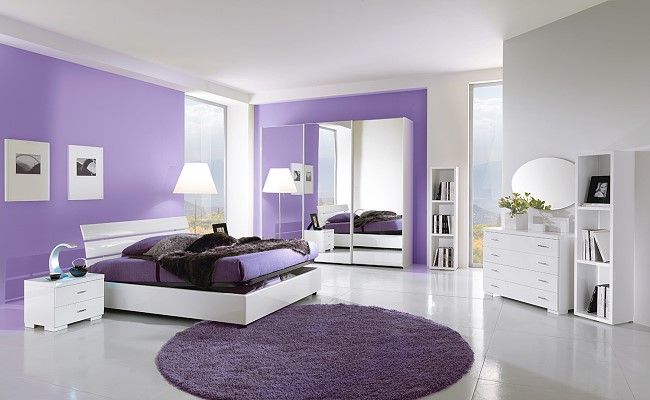
Pink colour is particularly happy and cheerful. Not many people could act aggressively in the presence of this colour.  Purple is also very suitable for a bedroom interior as it creates a very delicate and even luxurious atmosphere.


Red is basically evocative so if you struggle to fall asleep it is better not to choose red for your bedroom interior. If you still want to use it then do this simply for your sheets and covers (but not walls) as bed linen can easily be changed.
Various combinations of the colours above would cause even more different feelings, however the main and the most important idea here is to get to know yourself first and find out what feelings and emotions does one or the other colour bring in to your heart.